Evolving Treatment Landscape in Advanced Gastric and Gastroesophageal Adenocarcinomas
For many years, the treatment of advanced gastric and gastroesophageal junction (GEJ) adenocarcinoma was based on fluoropyrimidine- and platinum-based combination chemotherapy.1 Although these regimens can provide initial disease control, most patients eventually develop disease progression. In recent years, molecular profiling has improved our understanding of gastroesophageal adenocarcinoma and has led to the identification of clinically actionable biomarkers. This has enabled the development of targeted therapies and immunotherapies, including HER2-directed therapy and PD-1 blockade, which have improved outcomes in selected patients and are now part of first-line treatment2,3; however, their benefit remains largely limited to biomarker-defined subsets, such as HER2-positive, PD-L1-positive, and mismatch repair-deficient/microsatellite-unstable tumors. Additional therapeutic targets are therefore needed to broaden treatment options for patients with advanced disease.
In this context, Claudin 18.2 (CLDN18.2) has emerged as a novel therapeutic biomarker. Indeed, the clinical relevance of this biomarker has been confirmed through the success of zolbetuximab, which has increased the proportion of patients with advanced gastric and GEJ adenocarcinoma eligible for biomarker-directed treatment.4,5
CLDN18.2 Biology and Therapeutic Rationale
CLDN18.2 is a tight-junction protein normally expressed in differentiated gastric epithelial cells, where it helps maintain mucosal barrier function and epithelial polarity.6,7 It is the gastric-specific isoform of Claudin 18 and is absent in normal nongastric tissues, making it a useful therapeutic target. During malignant transformation, loss of cell polarity and disruption of tight junctions lead to surface exposure of CLDN18.2 on tumor cells, providing a basis for antibody-based therapy.7
Zolbetuximab is a monoclonal antibody that binds the first extracellular domain of CLDN18.2 and exerts antitumor effects through antibody-dependent cellular cytotoxicity and complement-dependent cytotoxicity.7,8 Early clinical studies showed that targeting CLDN18.2 could improve outcomes for patients with advanced gastric and GEJ adenocarcinoma, particularly in tumors with higher expression levels.9 These findings provided the rationale for subsequent phase III trials and for establishing a clinically relevant immunohistochemical cutoff.
Clinical Validation of CLDN18.2 as a Predictive Biomarker
The predictive value of CLDN18.2 was confirmed in the pivotal phase III SPOTLIGHT and GLOW trials.4,5 Both studies enrolled patients with HER2-negative, locally advanced unresectable or metastatic gastric or GEJ adenocarcinoma whose tumors were CLDN18.2-positive by immunohistochemistry (defined as moderate-to-strong membranous staining in at least 75% of viable tumor cells). In both trials, the addition of zolbetuximab to chemotherapy improved progression-free and overall survival compared with chemotherapy alone. These results established CLDN18.2 as a predictive biomarker for benefit from zolbetuximab-based therapy and supported its incorporation into routine clinical testing.
CLDN18.2 Immunohistochemistry and Scoring
CLDN18.2 expression is evaluated by immunohistochemistry as membranous staining in viable tumor cells.10,11 Adjacent non-neoplastic gastric epithelium, when present, usually shows strong (3+) membranous staining and serves as a helpful internal positive control, whereas lamina propria components such as lymphocytes, smooth muscle, and blood vessels are negative (Figure 1). Precursor lesions, including intestinal metaplasia and dysplasia, should be excluded from scoring. The current clinical cutoff is moderate-to-strong membranous staining in at least 75% of viable tumor cells. In practice, interpretation should incorporate both staining intensity and the proportion of tumor cells showing qualifying membranous expression.
Figure 1

(A) Normal gastric mucosa, hematoxylin and eosin (H&E), ×200. (B) Immunohistochemistry for CLDN18.2 shows strong membranous staining in the normal gastric epithelium, which serves as a useful internal positive control. In contrast, lamina propria components, including lymphocytes, smooth muscle, and blood vessels, are negative.
CLDN18.2 Expression in Gastric and GEJ Adenocarcinoma
Reported rates of CLDN18.2 expression in gastric and GEJ adenocarcinoma range from about 24% to 51%.4,5,12–16 Its distribution is often bimodal (Figure 2), with many tumors demonstrating either absent to minimal staining or strong, diffuse positivity (Figure 3).10 Among tumors that meet the clinical positivity threshold, staining is often relatively homogeneous. In tumors with intermediate levels of expression, intratumoral heterogeneity may occur in either a geographic or intermingled pattern (Figure 4). This heterogeneity is diagnostically relevant because it may contribute to sampling bias, especially in limited biopsy material, and can potentially lead to false-negative results. Discordance in CLDN18.2 expression across different tumor sites has also been reported in 5% to 27% of cases, including between paired primary and metastatic tumors.15, 17, 18 A discordance rate of 26% has also been reported in matched samples obtained before and after chemotherapy.15
Figure 2
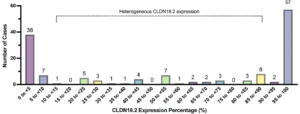
Most tumors show either absent to low expression (0% to <10%) or strong diffuse expression (≥90%). Among tumors meeting the clinical threshold for positivity (≥75%), staining is often relatively homogeneous.
Figure 3
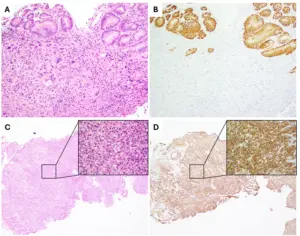
(A) Adenocarcinoma, H&E, ×200. (B) CLDN18.2 immunohistochemistry shows absence of staining in the adenocarcinoma component; adjacent non-neoplastic gastric mucosa serves as an internal positive control. (C) Adenocarcinoma, H&E, ×40. (D) CLDN18.2 immunohistochemistry shows diffuse strong membranous staining in the adenocarcinoma. Inset highlights signet-ring cells, ×400.
Figure 4
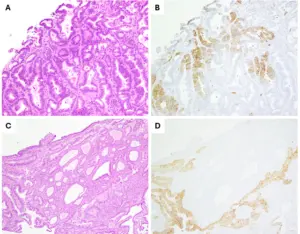
(A) Adenocarcinoma, H&E, ×200. (B) CLDN18.2 immunohistochemistry shows intermingled heterogeneity, defined as variable staining intensity within the same tumor glands, ×200. (C) Adenocarcinoma, H&E, ×100. (D) CLDN18.2 immunohistochemistry shows geographic heterogeneity, defined as spatially distinct areas of positive and negative staining within the tumor, ×100.
The relationship between CLDN18.2 expression and clinicopathologic features has been examined in multiple studies, but the results have been inconsistent. Reported associations with sex, age, stage, metastatic pattern, Epstein-Barr virus status, or histologic subtype have varied across cohorts10,13,15, 16,20–26, whereas some studies have found no significant correlation with clinicopathologic parameters.26–28 Overall, current data do not support a single consistent clinicopathologic profile for CLDN18.2-positive tumors. Available studies have also not demonstrated consistent prognostic significance for CLDN18.2 expression, indicating that it is primarily a predictive rather than prognostic marker.15,26,28
CLDN18.2 does not appear to correlate with HER2, PD-L1, or MMR status, supporting its role as a largely independent therapeutic biomarker.10,22 In our recently published study, approximately half of HER2-negative, PD-L1-negative, and mismatch repair-proficient (pMMR) tumors expressed CLDN18.2, suggesting that testing may identify patients who would otherwise lack biomarker-directed treatment options.10 CLDN18.2 can also co-occur with HER2 positivity or PD-L1 expression in a subset of patients, raising practical questions about treatment sequencing and combination strategies. 10,22
Current Clinical Trials and Future Directions
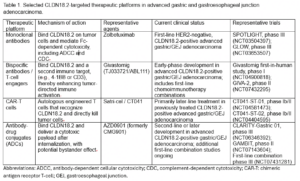
Following the success of zolbetuximab in the first-line setting, ongoing research is focused on expanding CLDN18.2-directed therapy beyond its current use. Areas of active investigation include combination strategies with chemoimmunotherapy, use in later-line treatment settings, and development of newer CLDN18.2-targeted platforms such as bispecific antibodies or T-cell engagers, antibody-drug conjugates, and CAR-T cell therapies (Table 1).29
Table 1
Several questions remain. These include how to manage tumors that coexpress CLDN18.2 with other actionable biomarkers, how stable CLDN18.2 expression is across tumor sites and over time, and how to optimize testing in small or heterogeneous samples. As newer CLDN18.2-directed agents enter clinical development, the next step will be to determine how they should be used alongside other biomarker-directed therapies in gastric and GEJ adenocarcinoma.
Conclusion
CLDN18.2 is now an established therapeutic biomarker in advanced gastric and GEJ adenocarcinoma. The success of zolbetuximab has confirmed the clinical relevance of this target and highlighted the importance of accurate biomarker assessment for patient selection. For pathologists, the main challenges lie in staining interpretation and tumor heterogeneity. Moreover, CLDN18.2 expands biomarker-directed treatment beyond the traditional HER2-, PD-L1-, and MMR-defined subsets. Ongoing studies will help clarify how CLDN18.2-targeted therapies should be used in different treatment settings and with other biomarker-directed therapies.
- Price TJ, Shapiro JD, Segelov E, et al. Management of advanced gastric cancer. Expert Rev Gastroenterol Hepatol. 2012;6(2):199-208; quiz 209.
- Bang YJ, Van Cutsem E, Feyereislova A, et al. Trastuzumab in combination with chemotherapy versus chemotherapy alone for treatment of HER2-positive advanced gastric or gastro-oesophageal junction cancer (ToGA): a phase 3, open-label, randomised controlled trial. Lancet. 2010;376(9742):687-697.
- Janjigian YY, Shitara K, Moehler M, et al. First-line nivolumab plus chemotherapy versus chemotherapy alone for advanced gastric, gastro-oesophageal junction, and oesophageal adenocarcinoma (CheckMate 649): a randomised, open-label, phase 3 trial. Lancet. 2021;398(10294):27-40.
- Shitara K, Lordick F, Bang YJ, et al. Zolbetuximab plus mFOLFOX6 in patients with CLDN18.2-positive, HER2-negative, untreated, locally advanced unresectable or metastatic gastric or gastro-oesophageal junction adenocarcinoma (SPOTLIGHT): a multicentre, randomised, double-blind, phase 3 trial. Lancet. 2023;401(10389):1655-1668.
- Shah MA, Shitara K, Ajani JA, et al. Zolbetuximab plus CAPOX in CLDN18.2-positive gastric or gastroesophageal junction adenocarcinoma: the randomized, phase 3 GLOW trial. Nat Med. 2023;29(8):2133-2141.
- Günzel D, Yu ASL. Claudins and the modulation of tight junction permeability. Physiol Rev. 2013;93(2):525-569.
- Sahin U, Koslowski M, Dhaene K, et al. Claudin-18 splice variant 2 is a pan-cancer target suitable for therapeutic antibody development. Clin Cancer Res. 2008;14(23):7624-7634.
- Sahin U, Schuler M, Richly H, et al. A phase I dose-escalation study of IMAB362 (Zolbetuximab) in patients with advanced gastric and gastro-oesophageal junction cancer. Eur J Cancer. 2018;100:17-26.
- Sahin U, Türeci Ö, Manikhas G, et al. FAST: a randomised phase II study of zolbetuximab (IMAB362) plus EOX versus EOX alone for first-line treatment of advanced CLDN18.2-positive gastric and gastro-oesophageal adenocarcinoma. Ann Oncol. 2021;32(5):609-619.
- Liu BL, Cleary JM, Shi J, Hornick JL, Zhao L. Claudin 18.2 and Other Therapeutic Biomarkers in Gastric and Gastroesophageal Junction Adenocarcinomas. Am J Surg Pathol. 2025;49(12):1233-1244.
- Fassan M, Kuwata T, Matkowskyj KA, Röcken C, Rüschoff J. Claudin-18.2 Immunohistochemical Evaluation in Gastric and Gastroesophageal Junction Adenocarcinomas to Direct Targeted Therapy: A Practical Approach. Mod Pathol. 2024;37(11):100589.
- Klempner SJ, Janjigian YY, Wainberg ZA. Claudin18.who? Examining biomarker overlap and outcomes in claudin18.2-positive gastroesophageal adenocarcinomas. ESMO Open. 2023;8(2):100778.
- Pellino A, Brignola S, Riello E, et al. Association of CLDN18 Protein Expression with Clinicopathological Features and Prognosis in Advanced Gastric and Gastroesophageal Junction Adenocarcinomas. J Pers Med. 2021;11(11):1095.
- Baek JH, Park DJ, Kim GY, et al. Clinical Implications of Claudin18.2 Expression in Patients With Gastric Cancer. Anticancer Res. 2019;39(12):6973-6979.
- Waters R, Sewastjanow-Silva M, Yamashita K, et al. Retrospective Study of Claudin 18 Isoform 2 Prevalence and Prognostic Association in Gastric and Gastroesophageal Junction Adenocarcinoma. JCO Precis Oncol. 2024;8:e2300543.
- Shitara K, Xu R-H, Ajani JA, et al. Global prevalence of claudin 18 isoform 2 in tumors of patients with locally advanced unresectable or metastatic gastric or gastroesophageal junction adenocarcinoma. Gastric Cancer. 2024;27(5):1058-1068.
- Choi E, Shin J, Ryu MH, Kim HD, Park YS. Heterogeneity of claudin 18.2 expression in metastatic gastric cancer. Sci Rep. 2024;14(1):17648.
- Son SM, Woo CG, Lee OJ, et al. Discordance in Claudin 18.2 Expression Between Primary and Metastatic Lesions in Patients With Gastric Cancer. J Gastric Cancer. 2025;25(2):303-317.
- Park G, Park SJ, Kim Y. Clinicopathological significance and prognostic values of claudin18.2 expression in solid tumors: a systematic review and meta-analysis. Front Oncol. 2024;14:1453906.
- Coati I, Lotz G, Fanelli GN, et al. Claudin-18 expression in oesophagogastric adenocarcinomas: a tissue microarray study of 523 molecularly profiled cases. Br J Cancer. 2019;121(3):257-263.
- Shinozaki A, Ushiku T, Morikawa T, et al. Epstein-Barr virus-associated gastric carcinoma: a distinct carcinoma of gastric phenotype by claudin expression profiling. J Histochem Cytochem. 2009;57(8):775-785.
- Kubota Y, Kawazoe A, Mishima S, et al. Comprehensive clinical and molecular characterization of claudin 18.2 expression in advanced gastric or gastroesophageal junction cancer. ESMO Open. 2023;8(1):100762.
- Rohde C, Yamaguchi R, Mukhina S, Sahin U, Itoh K, Türeci Ö. Comparison of Claudin 18.2 expression in primary tumors and lymph node metastases in Japanese patients with gastric adenocarcinoma. Jpn J Clin Oncol. 2019;49(9):870-876.
- Kim HD, Choi E, Shin J, et al. Clinicopathologic features and prognostic value of claudin 18.2 overexpression in patients with resectable gastric cancer. Sci Rep. 2023;13(1):20047.
- Hong JY, An JY, Lee J, et al. Claudin 18.2 expression in various tumor types and its role as a potential target in advanced gastric cancer. Transl Cancer Res. 2020;9(5):3367-3374.
- Kayikcioglu E, Yüceer RO, Cetin B, Yüceer K, Karahan N. Prognostic value of claudin 18.2 expression in gastric adenocarcinoma. World J Gastrointest Oncol. 2023;15(2):343-351.
- Kim TY, Kwak Y, Nam SK, et al. Clinicopathological analysis of claudin 18.2 focusing on intratumoral heterogeneity and survival in patients with metastatic or unresectable gastric cancer. ESMO Open. 2024;9(12):104000.
- Miki Y, Yoshii M, Miyauchi R, et al. Prognostic significance of Claudin18.2 expression in patients with gastric cancer. Sci Rep. 2025;15(1):39072.
- Nakayama I, Qi C, Chen Y, Nakamura Y, Shen L, Shitara K. Claudin 18.2 as a novel therapeutic target. Nat Rev Clin Oncol. 2024;21(5):354-369.