- Home
- Advocacy
- Latest News and Practice Data
- AMA Meeting: CAP Strengthens Network Adequacy, Fights to Prevent Future Medicare Cuts
At the interim meeting of the American Medical Association (AMA) House of Delegates, the CAP worked on policy to prevent future Medicare cuts to physician payment, strengthening network adequacy, protect the AMA/Specialty Society Relative Value Scale Update Committee (RUC), supporting residents and physicians when it comes to advocating for the creation and implementation of institutional policies, and address Medicaid unwinding.
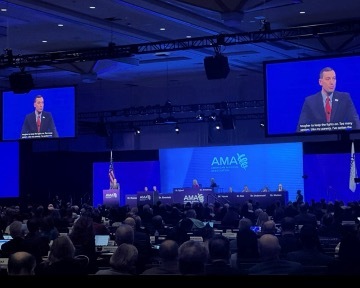
The CAP led a delegation of the Pathology Section Council, which includes the American Society for Clinical Pathology, American Society of Cytopathology the National Association of Medical Examiners, and the American Society of Dermatopathology. Nearly 700 physicians, residents, and medical students gathered in to consider proposals across a wide range of clinical practice, payment, medical education, and public health topics.
Strengthening Network Adequacy
The Pathology Section Council and CAP delegates supported an AMA report on network adequacy regarding the establishment and enforcement of a minimum network adequacy standard requiring all health plans to contract with sufficient numbers and types of physicians and other providers. The report would also direct the AMA to support requiring health plans to report on the number of physicians versus non-physicians in the network overall and by specialty/practice focus.
The CAP advocates for states to require health plans to have adequate networks of hospital-based physicians, including pathologists. We recommend states evaluate their approved and licensed insurance plans’ networks for in-network pathologist participation adequacy as well as the timeliness, proficiency, scope of pathology services provided, including genetic analysis, and utilization of pathology services. We believe that any state-approved health insurance plan network, including qualified health plans under State Health and Federal Insurance Exchanges/Marketplaces, be subject to plan adequacy requirements, enforced by each state.
Addressing Medicaid Unwinding
The Pathology Section Council and CAP delegates supported an AMA report addressing the loss of coverage and uninsurance rates following the return to regular Medicaid redeterminations and the end of the COVID-19 Public Health Emergency (PHE). The Medicaid unwinding has been described as the most significant nationwide coverage transition since the Affordable Care Act, with major implications for patients, physicians, and health equity. The AMA report added AMA policy that encourages state implementation of strategies to reduce inappropriate terminations from Medicaid/CHIP for procedural reasons; encourages states to provide continuity of care protections to patients transitioning from Medicaid or CHIP to a new health plan; and encourages state Medicaid agencies to make coverage status, including expiration of current coverage and information on pending renewals, accessible to physicians, clinics, and hospitals.
Protecting the RUC
The CAP worked with the Pathology Section Council and the AMA House of Delegates to defeat a resolution that would have disrupted the RUC process and harmed pathology’s efforts working with that entity.
Supporting Resident and Fellow Physicians
Resident and fellow physicians deserve a seat at the table when it comes to advocating for the creation and implementation of institutional policies that ensure their professional development, well-being and rights, according to policy adopted at the Interim Meeting.
Originally adopted as AMA policy more than a decade ago, the Resident and Fellows’ Bill of Rights offers a key framework for protecting resident well-being.
To ensure residents and fellows are part of the process of ensuring policies related to well-being are in their best interest—and that they have more freedom of movement if their employment at a residency or fellowship program becomes untenable—the House of Delegates adopted new policy to encourage the formation of peer-led resident and fellow organizations that can advocate for trainees’ interests.